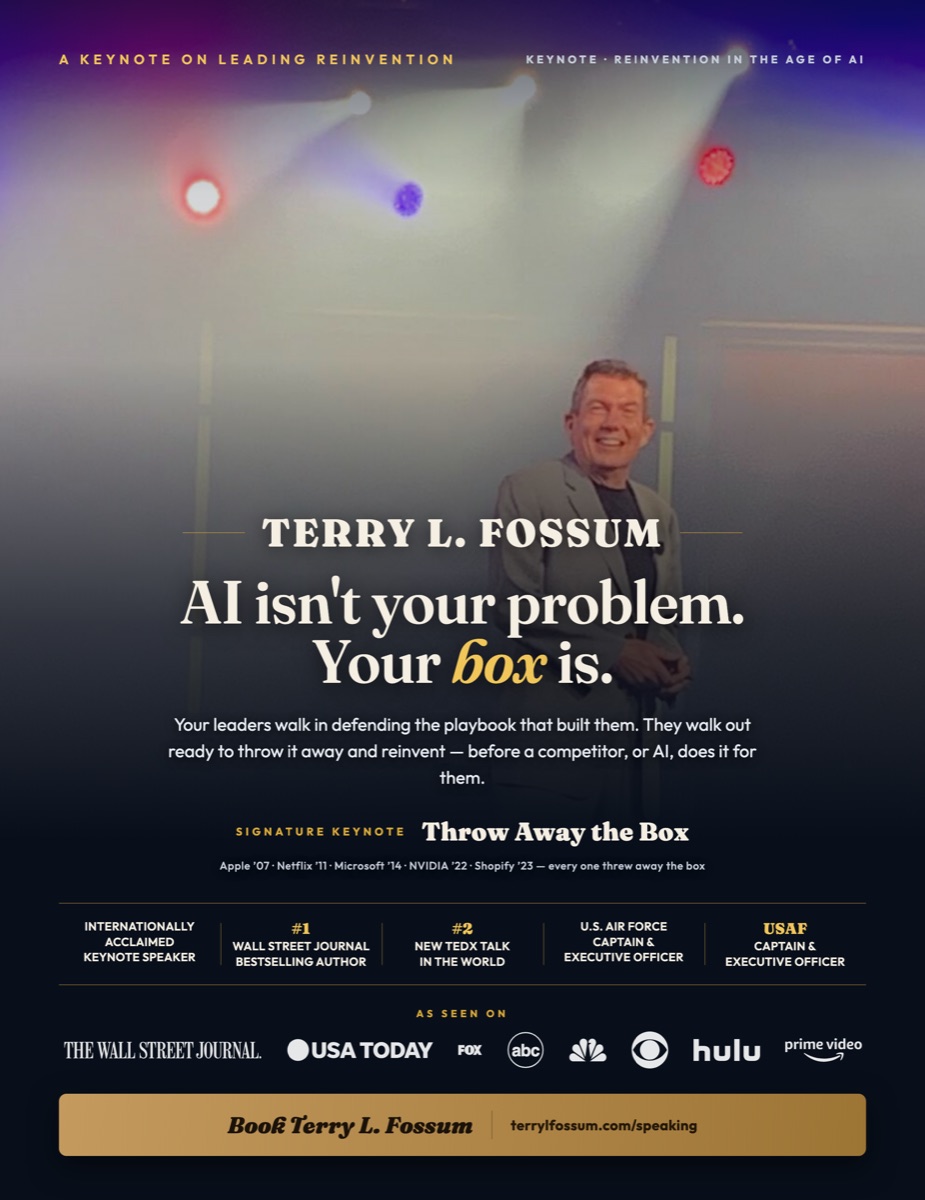
Don’t think outside the box.Throw it away.Then throw away the table.
How the companies that outlast AI actually think.
#1 Wall Street Journal bestselling author · #2 New TEDx Talk in the World · U.S. Air Force Captain & Executive Officer · Winner, Prime-Time Survival Competition
Business is changing at a pace nobody has seen before. Companies are floundering to keep up — and the ones that aren’t floundering are silently dying. The strategy is the easy half. Getting your people on board with change — that’s like trying to get a cat to take a bath: it might finally happen, but it’s going to get bloody. This keynote is about doing it without the blood. Build a fire under people and they stomp it out; build a fire within them and it burns forever. Built on Terry L. Fossum’s firsthand interviews with the operators inside NASA’s Columbia Return-to-Flight, Tesla under Musk-era velocity, the founder who created the backpacking category from scratch — and the commander of the International Space Station.
“You can’t inspect a damaged spacecraft in orbit.”
For twenty years, that was the dogma at NASA. When the Columbia broke up on re-entry in February 2003, seven astronauts were dead — and the same engineers who had told the world the inspection was impossible were being asked to make it possible.
Paul Hill, then Manager of Shuttle Operations at the Johnson Space Center, took the Return-to-Flight team. Senior NASA management expected him to come back in three months and reiterate the late-1970s conclusion: not solvable, sorry, we are not flying again.
Hill’s first move was different. He stopped his team from saying it was impossible. Not optimistic — precise. “We haven’t learned how to do this. That is different.” Within three months, his team had a working solution.
The seven astronauts did not come back. The next ones flew. That is what throwing away the box looks like at the level of real consequence — and the keynote opens with it because every audience in every industry is sitting on a version of that same problem.
Every company you admire broke its box at least once.
Apple did it in 2007. Netflix in 2011. Microsoft in 2014. NVIDIA in 2022. Shopify in 2023. The pattern is identical, the dates are public, and the AI era is shortening the runway between breaks. The question is not whether your company will break its box. It is whether you do it before the decline begins — or after.
Every leading company eventually hits a ceiling that is not made of competition or technology. It is made of its own past success. The processes, the customers, the experienced people — the very strengths the org celebrates — are also the walls.
Doubling down on what got you here cannot get you past the ceiling. Neither can "innovation initiatives" run from inside the box. The break requires somebody in the room to name a strength as a wall — and lead the dismantling.
Every company on the breakthrough side of the chart made the move before the decline. The keynote and the Box Audit exist to help your leaders see the wall and find the door — while the rising curve still has altitude to spend.
Not inspired. Equipped.
Audiences leave the Throw Away the Box keynote with four specific things — the mental model of throwing away the box, the reinvent-or-die pattern across five real operators, the Box Audit worksheet they can run with their leadership team Monday morning, and the permission to stop optimizing what no longer matters.
The mental model — throw away the box.
And why "outside the box" thinking quietly leaves the box in the room. Every audience walks out able to sketch the three-frame visual on a napkin and explain the whole framework to their team.
The reinvent-or-die pattern across five real operators.
NASA. Tesla. The North Face. E! Entertainment. And Terry's own arc. One framework, three intensities — so every leader in the room finds their own dial.
The Box Audit — a tool, not a feeling.
A three-question worksheet the audience runs in the room, then takes home to run with their own leadership team. Surfaces the unquestioned assumptions putting the organization at risk.
Permission to stop optimizing what no longer matters.
And the language to take that decision back to a team. Leaders walk out reframed from "loyal optimizer" to "honest reinventor" — the reframe that actually moves the organization.
Disruption doesn’t kill great companies.
The gravity of their own success does.
Roughly 90% of the original Fortune 500 are gone from the list. Kodak invented digital photography in 1975 and could not bring itself to kill its own film business until digital had killed it for them. Sears killed its own catalog in January 1993 — walking out of remote retail about eighteen months before Amazon was founded to take it. Blockbuster passed on a $50 million deal to buy Netflix in 2000. These are not stories of stupidity. They are stories of success — protecting the thing that worked, right up until the thing that worked became the thing that killed it.
And before you tell yourself that was a different era, look at Chegg — a healthy subscription business helping students with their homework, gutted in eighteen months by free AI doing the exact thing students had been paying Chegg for. Then look at NVIDIA — for most of its life a maker of graphics chips for video games, who walked their entire company toward AI before almost anyone else saw it coming. NVIDIA didn’t get lucky. NVIDIA threw away the box.
AI is the most violent change your industry will ever face. Change is exactly what this keynote is about.
This is not an AI talk. Terry isn’t here to explain large language models, and your people don’t need another forecast about the future of work. They need to know what to do when the ground under a profitable, well-run business starts moving — which is the question AI is now forcing on every industry at once.
Throw Away the Box works in any massive-change environment. AI is simply the one at your door. And the reason it lands in rooms staring down automation is that Terry didn’t read about it — he interviewed the people living inside it. He sat down with the leaders behind FANUC — the company automating the factory floor — and with Russell Varone at Tesla, where operating at the speed of change was the entire job. Their edge was never a better forecast. It was the willingness to throw away the box before it threw away them.
Your audience walks out understanding the one thing every AI strategy quietly depends on and no vendor will sell them: the courage to stop defending what used to work.
Five operators. One pattern.
Other speakers cite NASA and Tesla from Wikipedia. Terry interviewed the people who actually did it. The keynote is built on his firsthand reporting with the leaders behind five very different reinventions — and the one pattern across all of them.

Paul Sean Hill
After the Columbia broke up on re-entry in 2003, seven astronauts were dead — and the same NASA community that had told the world the inspection was impossible was being asked to make it possible. For twenty years, the official position had been: stop asking the question. Just fly carefully and hope.
Hill's first move was to forbid his team from saying it was impossible. Not optimistic — precise: "We haven't learned how to do this. That is different." Then they sat down and asked, in his words, "what are all the crazy-ass ways we could solve this problem that's supposed to be impossible?" Within three months, they had a working solution — built from a tile-repair material NASA had tested and rejected in the late seventies. Nothing changed about the material in thirty years. The only thing that changed was that one team kept the box, and one team threw it away.
When the team finally cracked it, they made a collage of photographs from labs all over the country, and across the bottom they wrote: "To believe in the heroic creates heroes." Hill had called them heroes to their faces for two solid years. It got inside them — and then they started behaving like the people he kept telling them they already were.
“Always fight the last battle first.”
— Paul Sean Hill
Russell Varone
At Tesla, Musk's operating framework wasn't optimization. It was first principles, applied through what Varone calls the "idiot index" — the ratio of a finished product's cost to the cost of its raw materials. A $1,000-per-pound rocket built from $10-per-pound raw aluminum has a 100:1 idiot ratio. That ratio doesn't tell you about the metal. It tells you about the box — a hundred layers of "the way we've always done it" stacked between raw material and finished part.
The Tesla Model S, for years, didn't come with a spare tire. A spare is forty to seventy pounds of mass you carry every mile of the car's life to solve a problem that almost never happens. Physics is the law; everything else is a recommendation. At Tesla, asking "why is there no spare tire" became a public rite of passage. Defending the box out loud was the one truly dangerous thing you could do.
Failure isn't the sin at Tesla — what Varone calls vicious accountability. Operating at 65% knowledge is fine; everyone does. But if you saw the box, and you didn't throw it away — that's not okay. Failure isn't the sin. Protecting the box is.
“Physics is the law. Everything else is a recommendation.”
— Russell Varone
Hap Klopp
Klopp came back from Vietnam having seen what military-grade synthetic materials could actually do, and built backpacking gear 50% lighter than anything on the market — creating a category that did not yet exist. Outside the existing box wasn't enough. The box was the wrong shape entirely.
Then he had the discipline to sell the company at the peak — before the gravity of the original success could pull the operation back to the original box. Most founders fall in love with the thing they built. Klopp built it, then threw it away on purpose.
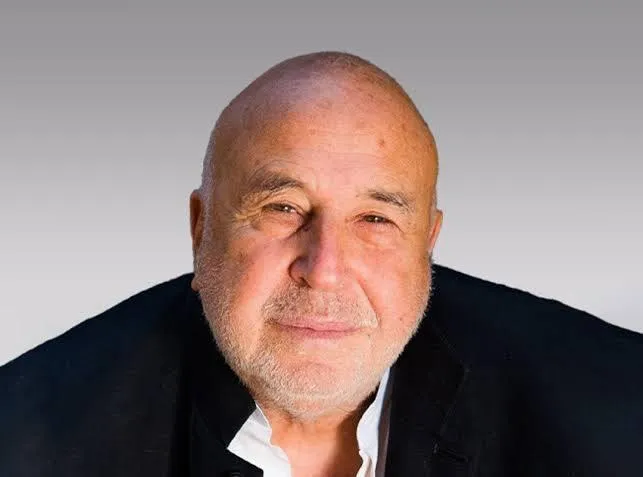
Larry Namer
Cable splicer in the Bronx to Movietime to E! Entertainment Television to Santa Barbara dubbed in Russian on Russian television to Metan launching American content into China. Four industries. Four reinventions. Same operator.
Namer is what it looks like when "throw away the box" is not one decision in a career — it is the career. The pattern across all four reinventions: never optimize the previous box. Build the next one. Then throw that one away too.
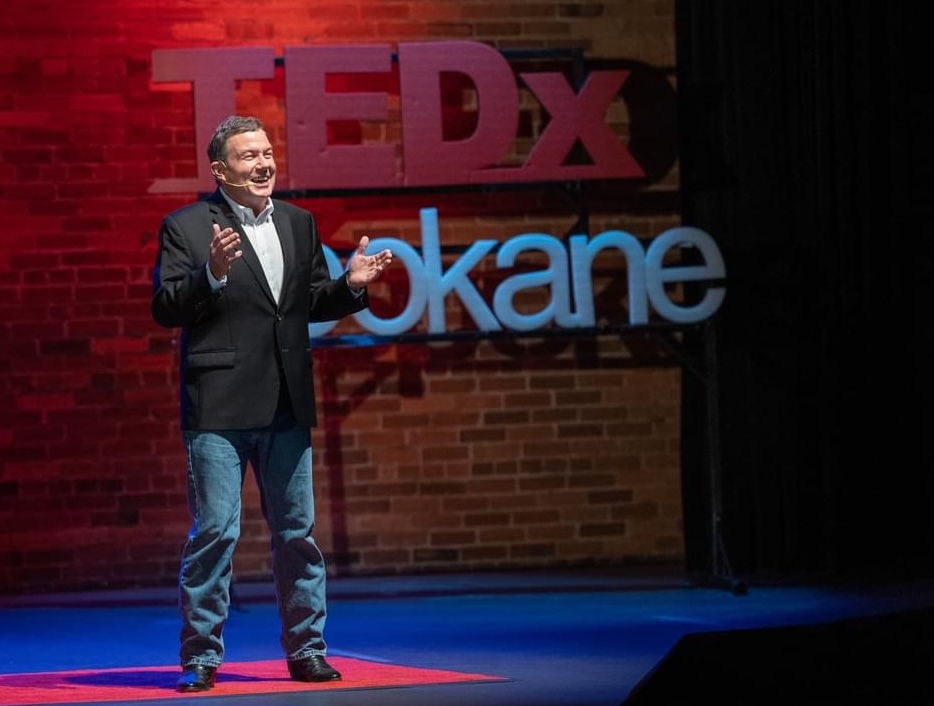
Terry L. Fossum
From McAllen, Texas — one of the poorest cities in America, where his father was killed during his high-school years — to U.S. Air Force Captain & Executive Officer of a Group of nuclear B-52 bombers, to the top fraction of 1% in direct sales worldwide, to winning the prime-time survival competition Kicking & Screaming, to a #1 Wall Street Journal bestseller.
Same person. Same set of principles. Applied in radically different rooms. Terry didn't research these archetypes from a distance — he lived their pattern. That is why he can teach it to your audience.
Lines the audiences keep quoting.
Verbatim lines from Terry L. Fossum’s firsthand interviews with the operators who actually threw away the box. Paul Hill’s framing for the team that returned the Space Shuttle to flight. Russell Varone on the operating principle behind Tesla’s velocity. The kind of sentences a keynote audience writes down and quotes for years afterward.
To believe in the heroic creates heroes.
Failure isn’t the sin. Protecting the box is.
The box walls are going right back up. And you’re already starting to atrophy.
Three questions. Sixty seconds. Find your box.
The Box Audit is what Terry hands every leader in the room when he delivers Throw Away the Box. Not a take-home swag bag — a working tool. Run it on yourself right now, in sixty seconds. Then run it with your leadership team this week, in ninety minutes. The argument that comes out of that ninety minutes is where reinvention actually starts.
AI and robotics make the gravity stronger and the cycle faster — and the companies being buried are not the ones that ignored the technology. They are the ones somebody else used it against.
Enterprises are pouring money into AI — and MIT’s 2025 State of AI in Business study found that 95% of enterprise gen-AI pilots deliver no measurable P&L return. That 95% is not failing because the technology is bad. They are failing because they bought the technology to optimize the old box — instead of using it to throw the box away.
The technology is not the problem. The box is.
You have permission.
If you’ve been working inside an organization that you quietly suspect is broken — not slow, not inefficient, but built wrong for the world it’s now living in — this keynote gives your leaders permission to stop trying to fix it from the inside.
The repair you’ve been attempting — the optimizing, the refining, the better signage — is the exact repair the next person in your chair will also attempt. And they will fail too. Not because the people aren’t smart enough. Because the box itself is the problem, and you cannot fix a box from inside it.
The person who finally says the box is the problem out loud is the most loyal person in the building. Everyone else is loyal to the box. They get to be loyal to the future. That reframe — from loyal optimizer to honest reinventor — is the shift Terry’s audiences carry home. It is the only version of leadership that is going to matter in the next ten years.
The rooms wrestling with reinvention.
Throw Away the Box is booked by the rooms where the unspoken theme is we have to change, and we’re not sure how. Terry makes it the spoken one — then hands the room a tool.
- 01Executive leadership summits & CEO forums
- 02Annual sales kickoffs and field-force events
- 03Manufacturing & industrial conferences
- 04Financial services & insurance leadership
- 05Franchise & multi-unit operator gatherings
- 06Trade associations facing category disruption
- 07Private equity portfolio company convenings
Delivered as a 45–60 minute keynote, or as a half-day leadership workshop. Every engagement researched and customized to the client’s industry and the specific reinvention pressure the room is facing.
The book is publishing. Get on the list for launch.
Throw Away the Box is on track for 2026. Get an early note when the book ships — plus the occasional update on a recent stage moment or operator interview worth seeing. No spam. No drip funnels.
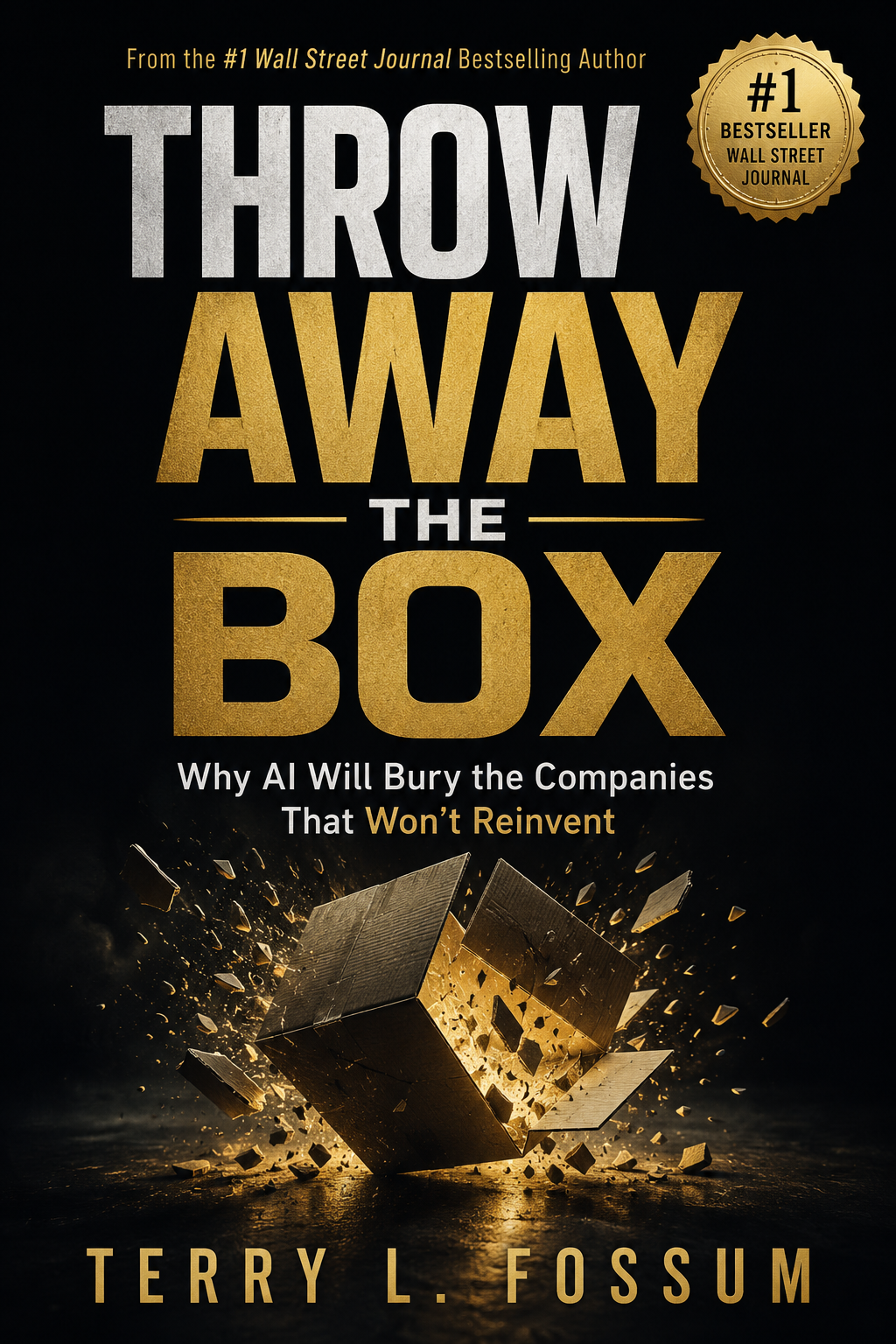
Throw Away the Box
The full framework, in print. Publishing 2026.
The keynote in long form. The five operator interviews (Hill at NASA, Varone at Tesla, Klopp at The North Face, Namer at E!, and Terry’s own arc), the complete gravity-of-success thesis, and the full Box Audit framework your team can run.
Bring this to your stage.
2026 keynote dates are limited. Book directly with Terry.
About Throw Away the Box.
01What is Throw Away the Box?+
02What is the Box Audit?+
03Who is this keynote for?+
04Does Terry customize the keynote for each event?+
05How do I book Terry?+
Building the buzz before he takes the stage.
Already booked Terry? Give your leaders something to anticipate. Drop the keynote flyer into your event app, signage, and pre-event emails — and use the ready-sized graphics for social and your conference channels.
Download the keynote flyer (PNG)↓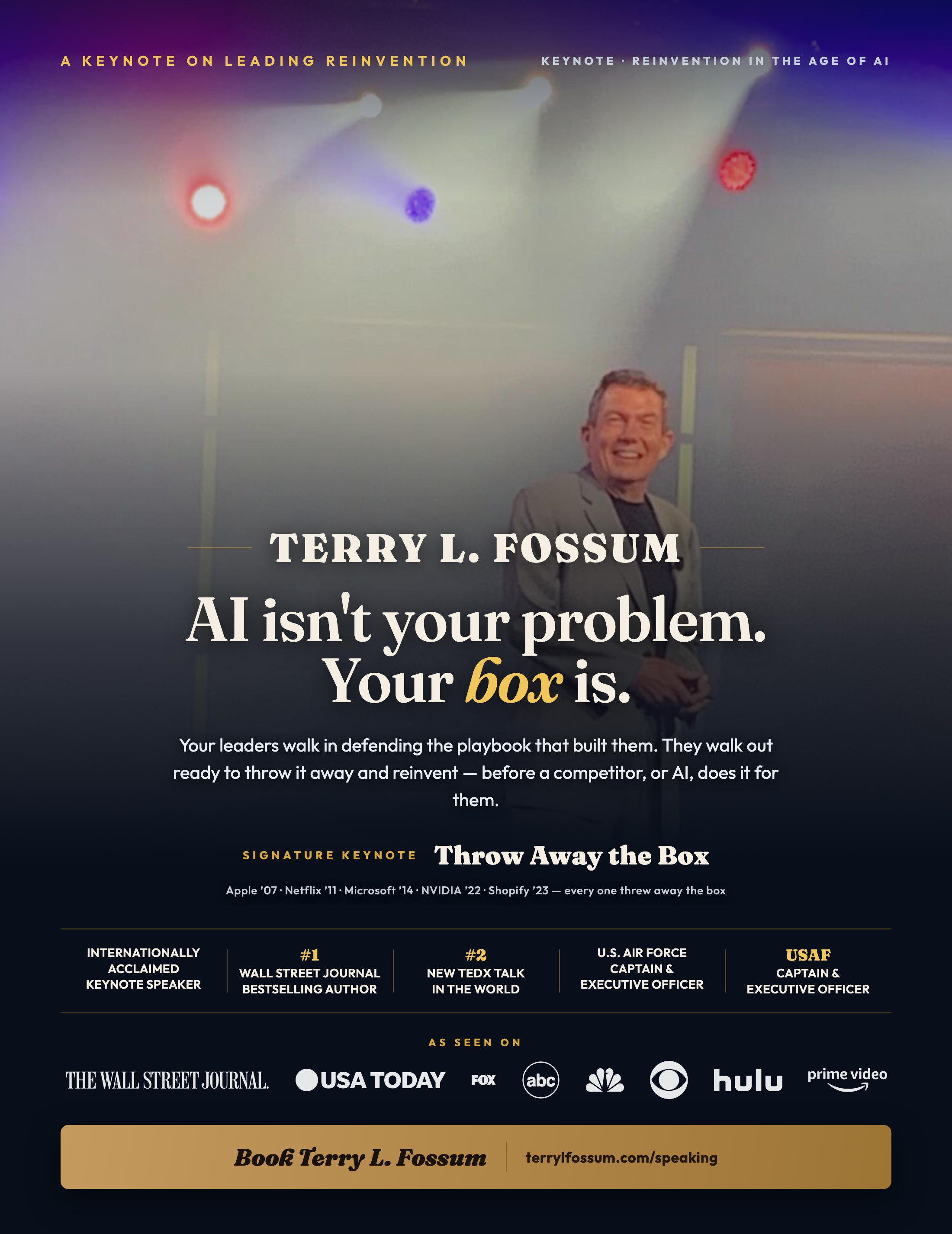
Social graphics: Facebook / LinkedIn · Instagram
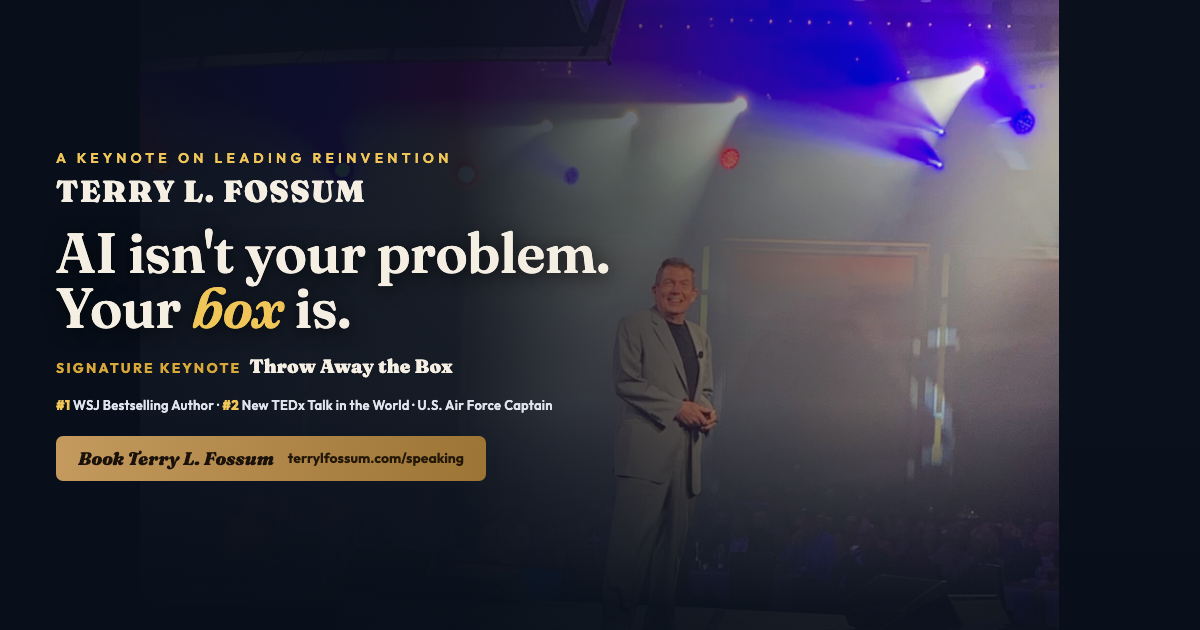
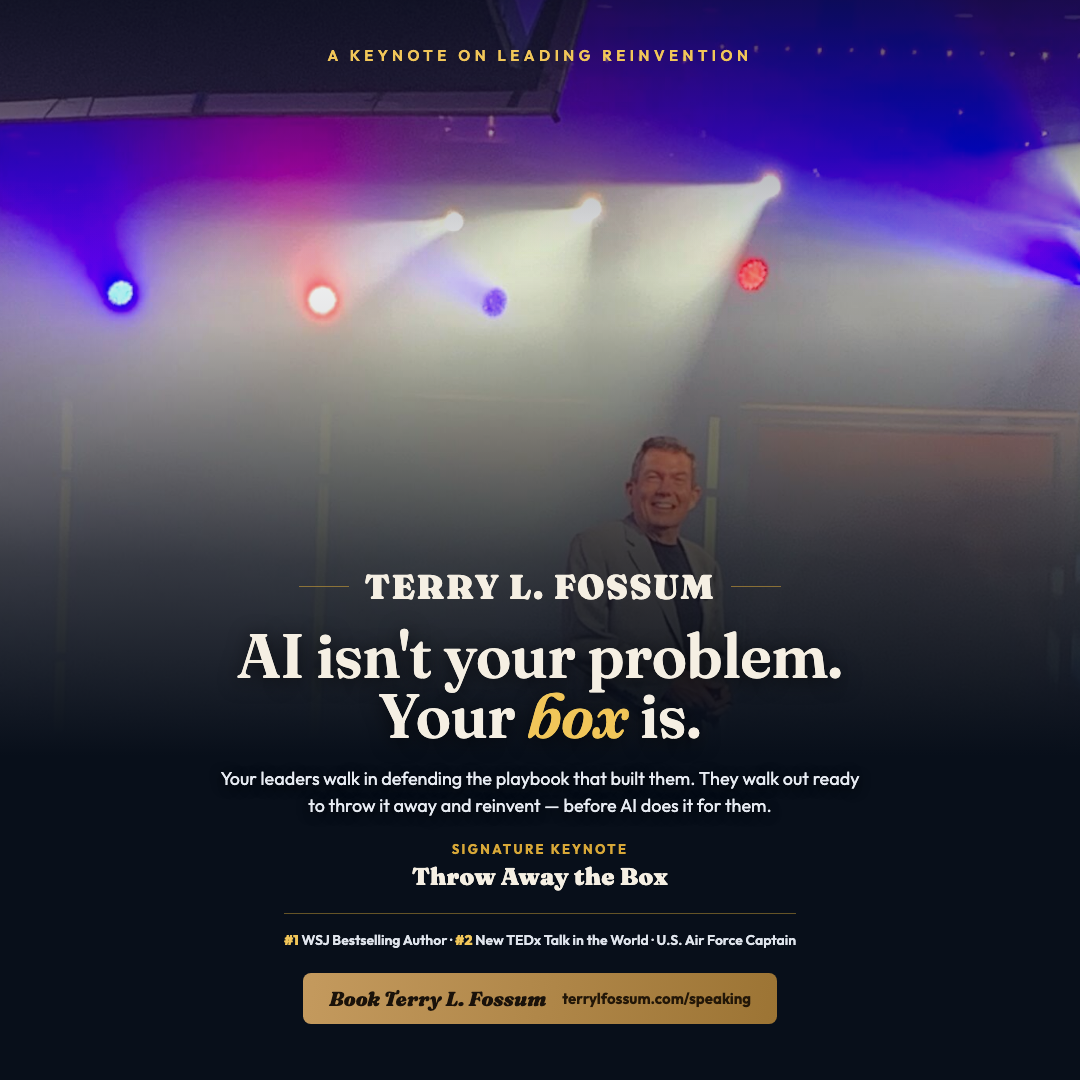
Making the case upward? Send the two-page Executive Briefing — written to be circulated to boards and leadership teams — and give every attendee the 10-step tool (PDF) after the keynote.